 piddonkadonk
My family has a group text. For about two years its main job was four people sending each other the same true crime documentary, a day apart, each one sure they found it first. Someone would ask if it was on Netflix or HBO Max. Someone would say Hulu. Someone would say they were already halfway through it. Nobody wrote any of it down.
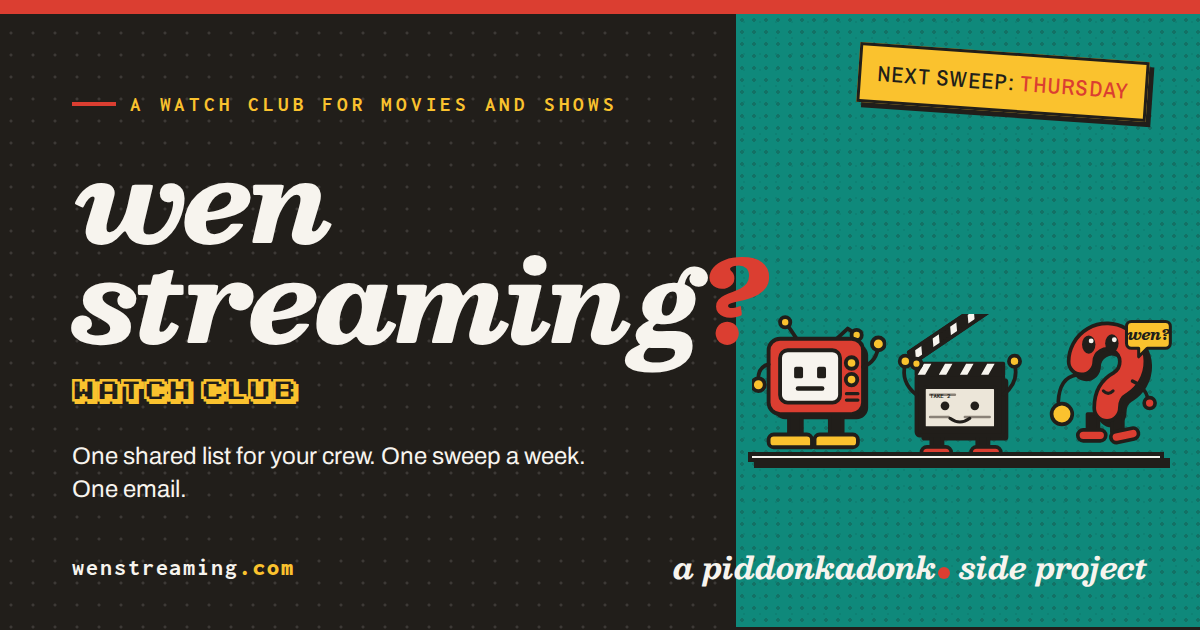
So I built a place to write it down. It is called wen streaming? and it lives at wenstreaming.com.
What it is
A watch club. One shared list for a group of people, which the site calls a crew. Everyone in the crew can add a movie or a show, tap in for a night, rate what they watched and argue about it in the comments. The list belongs to the crew, and so does the history. You have a profile, but the crew is the account that matters.
Every Thursday morning the site sweeps the big services, Netflix, HBO Max, Hulu, Prime Video, Disney+, Apple TV+, Peacock, Paramount+ and PBS, and files what is new and what is coming. Then one email goes to the crew: what landed, what people added, what anyone said about it. One email a week. No notifications, no daily nag. Thursday because releases cluster from Wednesday to Friday and most of the watching happens on the weekend, so the list is ready before anyone has to decide.
There is a cast. Sixteen objects, and only objects: a scarlet television with a bent antenna, a clapperboard, a question mark that carries its own dot around like a pet. Each one has exactly one opinion about movies. You pick one when you join. None of them could be mistaken for a person, which was the rule from the start.
The how-it-works page is drawn as a treasure map. Six stops, from your crew at the start to the scoreboard at the end of the week: most watched, harshest rater, biggest adder.
Why
True crime nights. My sister, my mom, my aunt and my cousin. Five people who all watch the same kind of thing and had no shared place to keep track of it.
The first version was a Notion database I kept by hand. It worked, which is how I knew the idea was fine and the tool was wrong. My family was never going to open Notion.
How it is built
The plain-language version.
The app is built in Lovable, a tool that writes the code from written instructions and hosts the result. Under it is Supabase, a hosted Postgres database, which holds the titles, the crews, the ratings and the comments. Posters, summaries, trailers and which service carries what come from TMDB, the community-run movie database. Scores from IMDb, Rotten Tomatoes and Metacritic come through OMDb, a second database that collects those. A scheduled job runs the Thursday sweep against TMDB's release data and refreshes where each title is streaming.
Then there is a second pass the feed cannot do. Once a week Claude reads the service press pages, the roundups and the true crime and documentary threads, and catches what the database misses: the small documentary that only got a press release, the British series on a channel nobody here has heard of, the library title that quietly came back. Those get filed to the same list, and the pass ends with a short list of titles I probably missed. The feed finds the obvious, and a well-briefed reader finds the good stuff.
The Notion database, 334 titles, was imported on day one, so the list never had an empty state to apologize for.
What is next
Crews for anyone. My family is the first crew. Anyone can make an account today, and the next job is making it dead simple to start your own crew and invite people with one link.
Where-to-watch links. Each title page will list the services that carry it in plain text and link out to them, so the list answers the only question anyone has at nine on a Friday night.
Crew plus, later. There is a shape for a paid tier and nothing behind it yet, so there is no pricing and no button. The free version is the product. A paid one shows up when there is something worth paying for.
If your group text does this too, start a crew at wenstreaming.com. Bring your people and a bad opinion.